At Home Care for Elderly: What Families Need to Know Before They Start
Most families do not start thinking about home care until something goes wrong. A fall, a hospital discharge, a quiet realization that mom is skipping meals. By then the decisions feel urgent and the options feel confusing.
Key Overview: At Home Care for Elderly at a Glance
- What it is: Non-medical personal care that helps older adults stay safely in their own homes, covering bathing, dressing, meals, housekeeping, and companionship.
- Who provides it: Home Health Aides (HHAs) or Personal Care Aides (PCAs) employed by a licensed home care agency.
- 2026 cost: Private-pay rates range from $35 to $48 per hour depending on your state, services, and schedule. If you have Medicaid, Medicare, or both, home care may be completely free.
- Free for eligible members: Medicaid-covered home care has no out-of-pocket cost. Cottage Home Care handles the full enrollment process at no charge and with no commitment required.
- Cottage Home Care: We serve New York, New Jersey, Maryland, Michigan, Connecticut, Florida, and 18 additional states. Call 516-367-2266 or request a free consultation.
In This Guide
- What is at home care for elderly?
- Home care vs. home health care
- Why families choose in-home care
- What does it cost in 2026?
- How to find a trustworthy caregiver or agency
- Signs it may be time to get help
- Common mistakes families make
- How to get started
- Frequently asked questions
What Is At Home Care for Elderly?
Quick Answer: At home care for elderly individuals is professional non-medical support that allows seniors to stay in their own homes. Caregivers help with daily personal tasks, household chores, and companionship based on each person's care plan.
At home care covers the practical daily support that becomes harder as we age but does not require a nurse or doctor. Think of it as the gap between "I can mostly manage" and "I need a nursing home." Most older adults fall somewhere in that middle ground for years.
A trained caregiver visits on a scheduled basis, whether a few hours a day or around the clock, and helps with tasks the senior can no longer do safely alone. The care plan is built around that specific person, not a facility's routine.
What personal care tasks does home care cover?
- Bathing and personal hygiene including hair washing, shaving, and skin care
- Dressing and help with compression socks or prescribed garments
- Toileting and incontinence care
- Mobility assistance including safe transfers from bed to chair
- Meal preparation suited to dietary needs and preferences
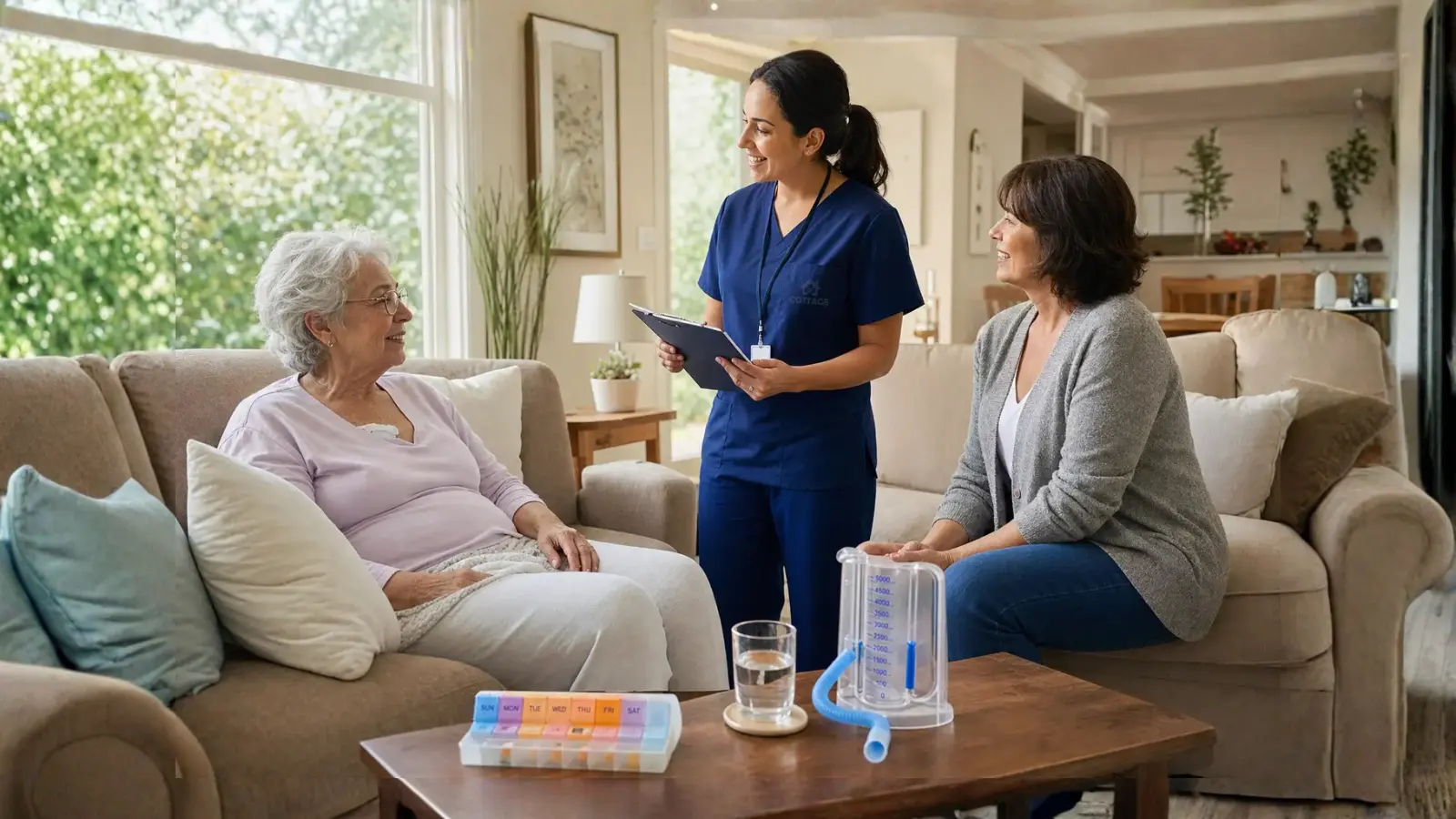
- Medication reminders — opening containers, reading labels, reminding when a dose is due (not administering medications)
- Light housekeeping: vacuuming, laundry, dishes, trash removal
- Grocery shopping and errands
- Companionship during the day and at mealtimes
At Cottage Home Care, every caregiver goes through background screening before placement. We match clients with caregivers based on language preference, dietary customs, and daily routine whenever possible.
Home Care vs. Home Health Care: The Difference Matters
Quick Answer: Non-medical home care covers personal assistance and daily living tasks. Home health care involves clinical services such as wound care, physical therapy, and skilled nursing provided by licensed healthcare professionals. They are separate service categories with different providers, eligibility rules, and payment structures.
This is the most common confusion families run into. The terms sound similar and some agencies use them loosely.
|
Non-Medical Home Care |
Home Health Care |
| Who provides it |
Home Health Aides, Personal Care Aides |
Registered Nurses, LPNs, Physical Therapists |
| Example tasks |
Bathing, dressing, meals, housekeeping, companionship |
Wound care, IV management, skilled nursing assessments, therapy |
| Medicare coverage |
Not covered as a standalone service |
Covered when medically necessary and ordered by a physician |
| Medicaid coverage |
Often covered through HCBS programs and state waivers |
Covered through state Medicaid home health benefits |
| What Cottage provides |
Yes — our core service |
HHA staffing support; skilled nursing for assessments only |
Medicare does not cover non-medical personal care as a standalone benefit. For ongoing personal care help, Medicaid home care programs or private pay are the usual routes.
Why Families Choose In-Home Care Over a Facility
Quick Answer: Most seniors strongly prefer to stay at home. In-home care makes that possible with personalized, one-on-one support in a familiar setting, usually at a lower cost than full-time residential care for those who need fewer than 40 hours per week.
- Care scheduled around real life. Your loved one eats when they want, sleeps on their own schedule, and follows their own routine rather than a shared facility timetable.
- Family stays involved. Family members can visit freely and stay involved in caregiving decisions.
- Caregiver matching. We match clients with caregivers who share the same language and cultural background when possible.
- Flexible hours. Care can start with a few hours a day and expand if needs change, without relocating your loved one.
- Cost comparison. Non-medical in-home care at 20 to 30 hours per week is often less expensive than nursing home or memory care placement, which can run $9,000 to $11,000 or more per month nationally in 2026.
That said, in-home care is not right for everyone. Someone who needs 24-hour skilled nursing or medical equipment requiring facility-level staffing may need a different level of care. We will always tell you honestly if we think a different setting would serve your loved one better.
What Does At Home Care for Elderly Cost in 2026?
Quick Answer: Home care rates typically range from $35 to $48 per hour depending on your state, the type of services needed, and how many hours of care are required. If you are covered by Medicaid, Medicare, or both, your home care services may be completely free — with no out-of-pocket cost to you.
Private-pay rates vary by location and care type. Urban areas and states with higher costs of living tend to be on the higher end of the range. The level of care needed — light assistance a few hours a week versus daily full-time support — also affects the total monthly cost.
| Hours Per Week |
Typical Private-Pay Monthly Cost |
Best Suited For |
| 10 to 15 hrs/week |
$1,400 to $2,900 |
Morning routines, meal prep, companionship a few days a week |
| 20 to 30 hrs/week |
$2,800 to $5,800 |
Daily personal care with family covering evenings and weekends |
| 40 hrs/week |
$5,600 to $7,700 |
Full weekday coverage, more complex daily care needs |
| 24-hour coverage |
$25,000+/month |
Continuous supervision, post-hospital recovery |
Rate range of $35 to $48/hr reflects variation by state, service type, and care conditions. Updated September 2026.
On Medicaid or Medicare? Your home care could be completely free.
If your loved one is enrolled in Medicaid, Medicare, or both, home care services through Cottage Home Care may cost nothing out of pocket. Medicaid-funded home care covers the full cost of personal care services for eligible members, including aide visits, care coordination, and related support — with no bills sent to the family.
Many families do not realize they already qualify. If your loved one has active Medicaid coverage, the process to begin home care is handled through the insurance plan, not through your wallet.
Cottage Home Care specializes in navigating these programs. We help families determine eligibility, understand which Medicaid type they have, and get services started — all at no charge. Our consultation is free. The eligibility check is free. The entire enrollment process is handled by our team at no cost and with no commitment required from you.
What helps pay for at home care?
- Medicaid home care programs. The most common route for covered care. In New York: Managed Long Term Care (MLTC) and the NHTD Waiver. In Michigan: the Medicaid Home Help program. Maryland and New Jersey offer Community First Choice and waiver options. When Medicaid is active, services typically cost the member nothing.
- Medicare. Covers skilled home health visits (nursing, therapy) when a physician certifies medical necessity. Combined with Medicaid, coverage is often broader and personal care costs may be fully covered.
- Both Medicaid and Medicare (dual eligible). If your loved one has both, they may have the strongest coverage available. Cottage Home Care can help you understand exactly what is covered under each plan.
- Long-term care insurance. Check the benefit cap, elimination period, and whether the policy requires using an approved agency.
- VA benefits. The VA Aid and Attendance benefit and Housebound allowance help eligible veterans and surviving spouses. VA caregiver support line: 1-855-260-3274.
- Private pay. No eligibility process or waitlist. Care typically begins within days. Cottage offers competitive rates matched to your specific schedule, service type, and care needs.
Not sure if your loved one qualifies for free home care? Call us and we will check for you. If they are on Medicaid, Medicare, or both, there is a good chance home care costs them nothing. Our consultation, eligibility check, and enrollment support are all completely free — no commitment required.
Get a Free Eligibility Check | Call 516-367-2266
Not sure what type of care your loved one needs? Our care team can walk through your situation, explain which programs may apply in your state, and schedule a free home assessment. No obligation.
Request a Free Consultation | Call 516-367-2266
How to Find a Trustworthy Caregiver or Agency
Quick Answer: A licensed home care agency provides background-checked, trained caregivers, backup coverage when your regular caregiver is unavailable, and a care coordinator who monitors quality over time. Hiring privately lowers the hourly rate but puts screening, payroll, and backup responsibilities on the family.
|
Licensed Agency |
Private Hire |
| Background checks |
Completed by agency before placement |
Your responsibility to arrange |
| Backup coverage |
Agency sends a replacement |
No backup; family absorbs the gap |
| Payroll and taxes |
Handled by agency |
Family may have employer tax obligations |
| Medicaid billing |
Handled by agency |
Usually not available |
| Hourly cost |
Higher than private hire |
Lower rate, more family management required |
Questions to ask any agency before you start
- Is the agency licensed in this state? What is the license number?
- Do caregivers go through state and federal background checks before placement?
- What training do your HHAs or PCAs complete?
- What happens if our regular caregiver cannot come in?
- Will the same caregiver be assigned consistently, or will it rotate?
- Does the agency carry general liability and workers' compensation insurance?
- How do I reach someone if there is a problem after business hours?
At Cottage Home Care, every placement goes through comprehensive state and federal background screening. We work to assign consistent caregivers rather than rotating unfamiliar faces through your loved one's home. Visit our locations page to find the office nearest you.
Signs It May Be Time to Get Help at Home
Quick Answer: The clearest signs are missed meals, poor personal hygiene, a recent fall or near-fall, inability to manage medications reliably, and a family caregiver running out of capacity. Any one of these is worth a conversation about adding professional support.
Families often wait longer than they should. The shift from managing to struggling happens gradually, and everyone can get used to a situation that is quietly becoming unsafe.
Physical and safety warning signs
- A fall has already happened, or there have been near-misses in the bathroom or getting up from bed
- Noticeable weight loss or evidence of skipped meals
- Medications are missed, doubled, or taken at the wrong times
- Personal hygiene has declined and the senior is resisting family help
- The home is significantly messier or less safe than before
- Chronic conditions such as diabetes, COPD, or heart failure are harder to manage daily
Social and cognitive changes
- Withdrawing from activities or people they used to enjoy
- Increased confusion about dates, appointments, or recent events
- Anxiety or distress when left alone
- Stopped driving but cannot get to appointments independently
Caregiver burnout
If you are the family member providing care and you are exhausted, getting professional help before you burn out is the responsible choice. According to AARP's 2026 research, family caregivers in the US provide enormous unpaid care each year, often at significant cost to their own health and finances. Supplementing with professional support means your loved one gets consistent care even when you cannot be there.
See our respite care services and family caregiver support resources.
Common Mistakes Families Make When Setting Up Home Care
Quick Answer: The most costly mistakes are choosing price over reliability, not verifying an agency's state license, failing to ask about backup coverage, and not checking whether Medicaid could significantly reduce out-of-pocket costs.
Confusing non-medical care with skilled medical care
If your loved one needs a nurse to manage wound care or a therapist after a stroke, a non-medical home care agency alone is not sufficient. Non-medical caregivers are legally prohibited from administering injections, changing wound dressings on broken skin, inserting catheters, or performing any skilled nursing task regardless of their background. These are state-level legal restrictions, not just agency policies. A good agency will tell you this upfront and help you identify what skilled services your loved one also needs.
Prioritizing the lowest hourly rate
Background screening, training, and liability insurance cost money. When an agency quotes unusually low rates, it is worth asking which of those elements have been reduced. A poor caregiver match in your loved one's home is far more disruptive and expensive to fix than paying a fair rate from the start.
Not asking about backup coverage in advance
Caregivers get sick. Ask directly before you start: "What happens if our caregiver cannot come in today?" You should have a clear answer before you ever need it.
Not checking whether Medicaid programs apply
Many families pay entirely out of pocket for months without realizing their loved one could qualify for Medicaid-funded home care. Eligibility is based on income, assets, and functional need, and the rules vary by state. We help families navigate this in New York, New Jersey, Michigan, Maryland, Connecticut, and Florida, among others.
How to Get Started with Home Care for an Elderly Loved One
Quick Answer: Start by writing down what tasks your loved one currently needs help with. Then contact licensed agencies in your area, ask about screening and backup coverage, and request a free home assessment. Most reputable agencies complete an assessment before placing a caregiver.
- Write down the current gaps. List what your loved one struggles with now: bathing, cooking, medications, getting around safely. Be honest about what is actually happening, not what used to work.
- Talk to the person who needs care. This conversation goes better than expected when framed as "how do we help you stay home" rather than "we think you need help."
- Contact the physician. The primary care doctor can clarify whether skilled nursing or therapy is also needed and help document functional limitations for Medicaid or insurance purposes.
- Check Medicaid eligibility. If your loved one is on Medicaid or may qualify, ask specifically about home care programs in your state before committing to private pay.
- Contact home care agencies in your area. Ask about licensing, caregiver screening, backup coverage, and language or cultural preferences.
- Schedule a free assessment. Use the visit to evaluate how carefully the agency listens and how clearly they explain the proposed care plan.
Our checklist for elderly living alone and home care vs. nursing home comparison may also help.
Frequently Asked Questions
Does Medicare pay for at home care for elderly?
Medicare covers skilled home health services such as nursing and physical therapy when a physician certifies medical necessity and the patient meets homebound criteria. It does not cover non-medical personal care such as bathing or meal preparation as a standalone benefit. For ongoing personal care support, Medicaid programs or private pay are the typical options.
Can a family member be paid to be a caregiver?
In many states, yes. Medicaid programs including Community First Choice, CDPAP in New York, and Michigan's Home Help program allow certain family members to be paid as caregivers for a Medicaid-eligible relative. Spouse-to-spouse and parent-to-minor-child arrangements are generally excluded. Adult children, siblings, and other relatives can often qualify depending on the state and program. See our family caregiver compensation guide.
What is the difference between an HHA and a PCA?
A Home Health Aide (HHA) completes a formal state-regulated training program, usually 75 hours or more, and is typically required for Medicaid-funded home care. A Personal Care Aide (PCA) provides similar daily living assistance but may fall under a different regulatory framework depending on the state. The tasks they perform for non-medical clients are often similar in practice. The distinction matters mainly for Medicaid billing eligibility. See our HHA vs. caregiver comparison.
How quickly can home care begin?
For private-pay arrangements, care can often begin within a few days of completing an initial assessment and signing a service agreement. Medicaid-funded care requires eligibility determination and sometimes a functional assessment by a state worker, which can take several weeks or longer. Private pay can bridge the gap while waiting for Medicaid approval.
Can a home caregiver administer medications?
No. Non-medical caregivers including HHAs and PCAs are not permitted to administer medications. Their role is limited to opening containers, reading labels aloud, reminding clients when a dose is due, and handing them a glass of water. Administering injections, managing IV lines, or adjusting dosages requires a licensed nurse.
What states does Cottage Home Care serve?
Cottage Home Care operates across 23 states including New York, New Jersey, Maryland, Michigan, Connecticut, Florida, California, Georgia, Illinois, Pennsylvania, Virginia, and more. Headquarters: 294 West Merrick Road, Suite 12, Freeport, NY 11520. Visit our locations page or call 516-367-2266.
The Most Important Next Step
Most families who call us have been thinking about this for months. They noticed the changes, had the worried conversations, and put off making the call because it feels like a big decision. It is. But the practical first step — a free assessment to understand what level of help would actually make a difference — costs nothing and commits you to nothing.
We have been helping families work through this since 2019. We work with Medicaid programs, private pay, and long-term care insurance across more than 20 states. We will tell you honestly if we think a different care setting would serve your loved one better, because getting the care right matters more to us than filling hours.
Call 516-367-2266, email info@cottagehomecare.com, or request a free home care assessment online.
Cottage Home Care Services
294 West Merrick Road, Suite 12, Freeport, NY 11520


 Sabine DurgaramDPS/RN